




A shadow creeping across your peripheral vision. A sudden shower of floaters where there were none before. A flash of light with no clear source.
These aren’t symptoms to wait out or dismiss as a bad night’s sleep. They may be signs of retinal detachment, a medical emergency that requires prompt evaluation from an eye doctor to prevent permanent vision loss.
The retina is a thin layer of tissue lining the back of the eye. It captures light and sends visual information to the brain; when it shifts from its normal position, vision begins to fail quickly.
Retinal detachment affects approximately 180,000 people in the United States each year, and it can strike at any age. Keep reading to learn what the warning signs look like, who faces a higher risk, and when to call your eye doctor.
What Happens When the Retina Detaches?
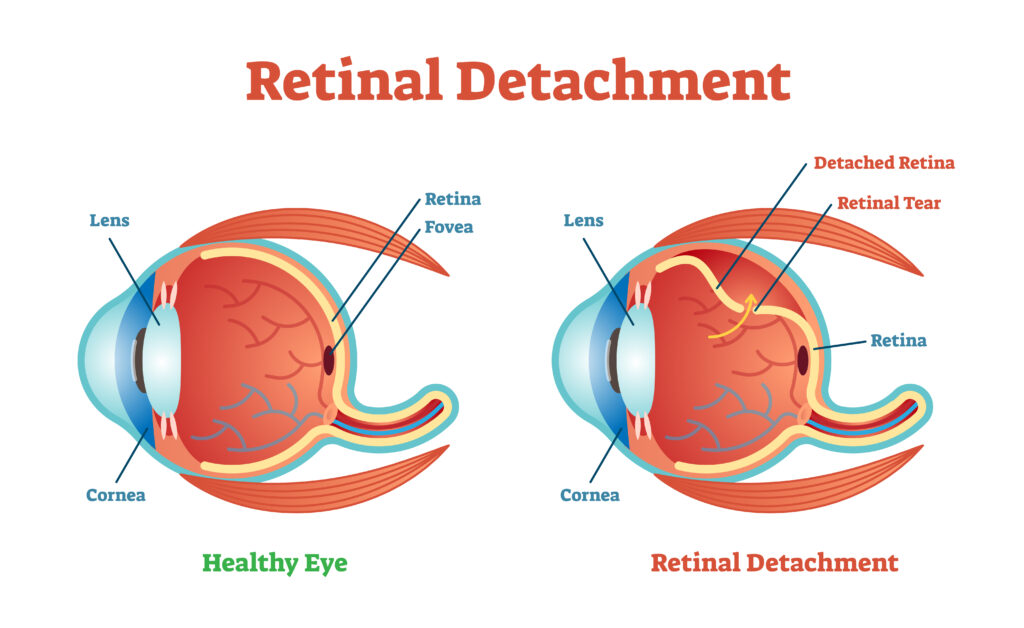
The center of the eye is filled with a clear, gel-like substance called the vitreous. In younger eyes, this gel is firm and stays comfortably in place.
As you age, the vitreous gradually shrinks and may pull away from the surface of the retina. Most of the time, this process happens without incident. But occasionally, the vitreous pulls hard enough to create a tear in the retinal tissue.
Once a tear forms, fluid from inside the eye can seep underneath the retina and lift it away from the back of the eye wall. When the retina loses that contact, it also loses its blood supply and stops functioning.
Vision in the affected area dims, distorts, or disappears entirely, depending on how much of the retina has separated. Without timely treatment, complete detachment can result in permanent blindness in that eye.
6 Retinal Detachment Symptoms You Should Never Ignore
Retinal detachment symptoms often appear suddenly and can escalate quickly. Some people notice only one sign; others experience several at once. If you recognize any of the following, contact an eye doctor immediately or go directly to the emergency room.
1. A Sudden Increase in Floaters
Floaters are the small dots, lines, or cobweb-like shapes that drift across your field of vision. Seeing an occasional floater is common and usually harmless. But a sudden surge in floaters, especially after years of seeing very few, can signal a retinal tear or the early stages of detachment.
2. Flashes of Light
Brief flashes or streaks of light, sometimes described as lightning bolts or camera flashes, often occur when the vitreous tugs on the retina. Occasional flashes can be normal, but frequent or persistent ones, especially paired with other symptoms, warrant immediate attention.
3. A Shadow in Your Peripheral Vision

One of the most recognizable signs of retinal detachment is a dark shadow at the edge of your visual field. This shadow may look like a curtain slowly being drawn across the side of your vision. It reflects the area of the retina that has lifted away from the eye wall.
4. A Gray Curtain Moving Across Your Central Vision
As detachment progresses, the shadow can advance toward the center of your vision. When the central area of the retina, known as the macula, becomes involved, detailed vision for reading, driving, and recognizing faces can be severely affected.
5. Blurry or Distorted Vision
Some patients describe their vision as wavy or warped before a detachment becomes obvious. This distortion can be subtle at first and is easy to dismiss. If your vision feels off in a way that glasses or contacts don’t explain, it deserves a closer look.
6. A Painless, Yet Significant Change in Vision
Retinal detachment does not cause pain. This is one reason people delay seeking care. Because there is no discomfort, it can feel tempting to wait and see if things improve on their own; however, any significant vision change is still a reason to call your eye doctor.
Who Faces a Higher Risk for Retinal Detachment?
Retinal detachment can happen to anyone, but certain factors increase the likelihood:
- People over 50 are more prone to vitreous shrinkage and retinal tears
- High nearsightedness, which stretches the retina thinner than normal, making it more susceptible
- People who have had cataract surgery, glaucoma surgery, or any other procedure inside the eye
- A prior detachment in one eye
- Serious eye trauma, such as a direct blow to the eye, can trigger detachment
- Certain conditions, like diabetic retinopathy, which affects the blood vessels within the retina
When to Seek Medical Attention
Retinal detachment is a true emergency. The sooner treatment begins, the better the outcome is likely to be. If only a small portion of the retina has detached, vision can often be preserved. But as detachment spreads, the risk of lasting damage grows with every passing hour.
If you notice new flashes, a sudden wave of floaters, or any kind of shadow or curtain in your vision, do not wait for a scheduled appointment. Call your eye doctor immediately and describe your symptoms.
If your practice cannot see you the same day, go to an emergency room where an ophthalmologist can evaluate you. Time matters in a way that is difficult to overstate when the retina is involved.
How Retinal Detachment Is Treated

Treatment depends on the size and location of the detachment, as well as how long it has been present. For small tears caught early, a laser or a freezing probe (cryotherapy) can seal the break before fluid can accumulate beneath the retina. These treatments can often be performed in an office setting.
When detachment has already occurred, surgery is typically necessary. Pneumatic retinopexy involves injecting a small gas bubble into the eye to press the retina back against the eye wall while it heals.
Vitrectomy removes the vitreous gel and replaces it with gas or oil to support the retina from the inside. A scleral buckle, made of soft silicone, is sewn around the outside of the eye to gently push the wall inward and hold the retina in place.
These procedures may be used alone or in combination, depending on the case. Reattachment is successful in about 80-90% of cases. Vision improvement typically begins four to six weeks after surgery, though full recovery can take a year or more.
If Your Vision Changes, Act the Same Day
Retinal detachment symptoms rarely give much warning before they become serious. The window for protecting your vision is small, and it closes faster than most people expect. If you see sudden floaters, flashing lights, or a shadow moving across your field of view, those signs are enough reason to pick up the phone right now.
The team at The Omaha and Lincoln Eye and Laser Institute provides prompt evaluation and expert retinal care. If you are experiencing any symptoms of retinal detachment, seek immediate care or schedule an urgent evaluation at our Omaha or Lincoln, NE locations.